
Why Public School? Why not Public School?
I used to believe that public education was the right spot for almost every family. I was a public school kid until I graduated from high school and that education served me beautifully.
Sure, there was that year when I begged my parents to let me apply to Choate (spoiler: they didn’t), which might have also been the same year that I begged them to let me homeschool (spoiler: they didn’t).
But despite that, I did well at and enjoyed my public schools, went on to continue my education at a Seven Sisters college (shout out to all my Smithies!), and have forged a path through life that’s been incredibly rewarding, if not always easy.
Professionally, I started my career as a certified public school teacher, first as long-term substitutes in Connecticut, and then as a full-time English teacher at the Boston Renaissance Charter School.
There have been many times over the course of my career where I’ve recommended that a family who had previously been at an independent school try their local public school instead.
Because I believe in public education. And I think that for many families, the public schools have historically been able to offer services that independent schools just don’t have the resources to support.
And I still believe that … BUT … now that recommendation comes with a caveat.
A week and a half ago, I heard Dr. Miguel Cardona talk at the Salisbury Forum.* Dr. Cardona went from Meriden public schools to becoming Connecticut's youngest principal at 27, to serving as the 12th U.S. Secretary of Education, so his case for public school wasn't theoretical. It also wasn't rosy about money or resource allocation.
Dr. Cardona shared that in 1975, the federal government committed to covering 40% of the extra cost of educating a student with a disability. The National Education Association now puts the actual federal share at under 12%. The promise of support was gradually abandoned over the course of fifty years, with the gap landing on our districts’ budgets.
Some districts have the cushion to absorb that gap. Many (many) don’t.
If your child has special education needs and you live in a district with dwindling student numbers or lower levels of available tax resources, the promise of a public education may not be quite as promising.
Mental health support is equally at risk. Cardona shared an anecdote from a superintendent whose district had a $90 million federal grant benefitting mental health resources unceremoniously cut from their budget. While I can't confirm that specific number or the reasons for the cut, I can confirm the pattern behind it: last spring, the federal government pulled roughly $1 billion in school mental-health grants nationally, money that had funded counselors and social workers in nearly 300 districts.
Whatever the reasoning, the effect on schools is like pulling a rug out from under already fragile furniture: destabilizing with little warning – impacting kids who were already working overtime to hold themselves together.
None of this means public school itself is broken, or that leaving is the answer, or that staying is.
It means the system is more fragile, and more enrollment-dependent, than any of us would like. And given that, what decision do you make for your own child who needs help right now?
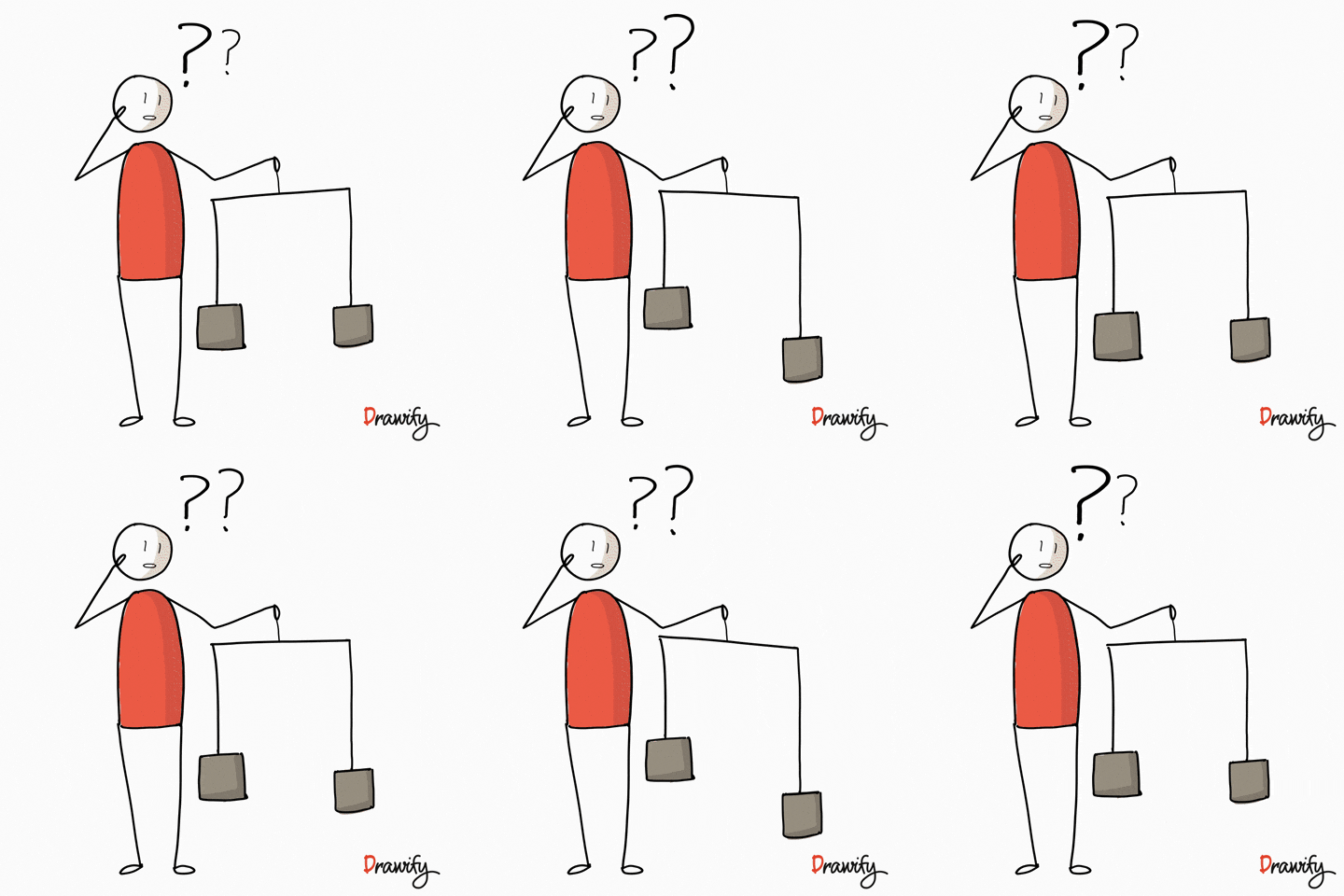
That's the real question. Not public vs. private vs. charter vs. online vs. any other segment in the educational setting Venn diagram. Just this: What does this specific school actually have, at this moment, for this specific set of needs?
We help you assess that question in Module 2 of the [School Search Workshop — LINK: couldn't find or confirm this URL, dropping in a placeholder rather than guessing] and answer it in Module 3. And if your local public school is the option, we’ll help you understand how to get your child the support they need, inside or outside of the system.
More information on the workshop lands this Friday. If you want it delivered straight to you, The Bridge is where it'll go out first.
Until then, keep fighting for education – for salaries, for facilities, for funding.
We're in this together.
*This was the same series where I connected with Casper Ter Kuile back in the spring.
Rebekah Jordan, M.Ed., is founder and partner at Crossbridge Consulting, where she helps families navigate school placement, therapeutic programs, and the decisions that come with a child who needs something different.