
How to Talk to Your Adolescent or Young Adult Child
I was raised in a family where social skills mattered. Maybe too much. When you shook a person's hand, you did it firmly, and looked them in the eye. When my kids were younger, they attended a private school where every morning they were met by the headmaster who shook their hand and modeled how to do it, and do it well. My husband likes to say that the men in my family were born in a blue blazer.
Nobody teaches conversation
In my work, we are often focusing on social skills development for neurodiverse kids. But what about neurotypical kids? Unfortunately, many kids these days are lacking social skills, especially in the conversational realm, and they don't know how to speak with one another, let alone how to speak with adults. Post-Covid, human interaction has been altered, and many kids were home with no social interaction during key developmental years. Conversation needs to be taught. It should be taught in school alongside reading, writing, and arithmetic, because conversation that fosters connection is foundational to success and well-being.
Why your teenager gives you one-word answers
Parents of adolescents and young adults often complain that their children don't talk with them. They get yes and no answers to their questions, and they don't know how to pull their child into a more meaningful conversation. Remember, it is developmentally appropriate for adolescents and young adults to want autonomy and separation from you. They want to differentiate from you. This stage requires parents to be more intentional when trying to engage their adolescent or young adult child in conversation.
Alison Wood Brooks on what makes a conversation work
Brooks is a professor at Harvard Business School who has spent more than a decade recording and coding conversations, including speed dates, negotiations, first meetings, and police traffic stops. Her book Talk: The Science of Conversation and the Art of Being Ourselves (Crown, 2025) sorts what she found into four maxims, Topics, Asking, Levity, and Kindness, and she also argues that conversation should be taught in schools, validating my similar thought. The book was written for a business audience, and many of the examples involve negotiation and hiring, but the findings are useful to parents, too.
Her diagnosis of what goes wrong belongs ahead of the maxims: egocentrism. In her words, we have trouble "getting past our own self-centeredness, our own egocentrism, that we focus so singularly and naturally on our own point of view." Everyone does this, but there are strategies and tools around it. Tools that get you to more meaningful conversation with the people in your life, including your children, and to a deeper relationship with them.
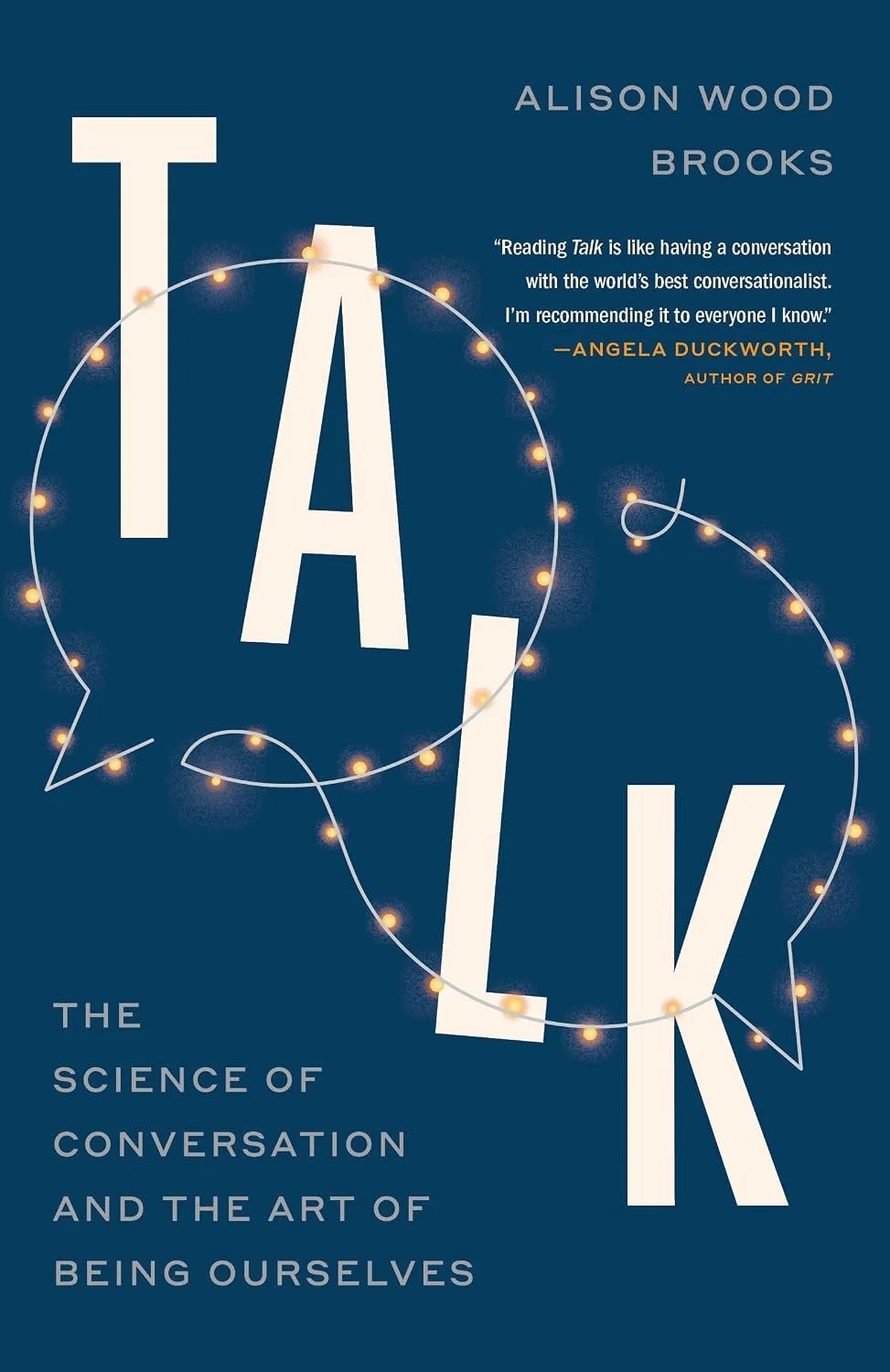
We highly recommend this book.
Maxim 1: Topics
Parents often have a list of things in their head that they want to raise with their child; it's just a matter of finding the right moment, right?! Their child anticipates it coming and is prepared to deflect. It's the subject that the parent deems necessary to cover, but not the one the kid will want to talk about, and the kid hears it coming before it's left your mouth. They feel your hesitant energy.
Some of those conversations have to happen. You are the parent, and there are things that need to be said about the grades, the money, the car, the way they spoke to their grandmother. A few things make these go better.
Choose one thing to correct. Don't snowball, and don't pile on, you did this and then that and then the other thing from last month.
Decide ahead of time whether it is worth it to speak up at all, because not everything on the list has to be raised.
Name the subject instead of circling it. Your child can feel you working up to something, so get to it directly.
Don't save it for the end. A correction delivered in the last two minutes of a phone call is the last thing they hear from you and leaves no time for them to recover from it.
Those conversations matter, though they should not be most of what happens between you. When the majority of your interactions are corrective, your child starts hearing every conversation as a correction or criticism. The rest of your conversations, the ones that aren't about anything, are the ones that build the relationship. These are what make the hard ones possible.
Brooks suggests spending thirty seconds thinking about topics before a conversation. She also describes topics as a pyramid with small talk at the bottom and deep talk at the top, and calls small talk a launch pad to more meaningful conversation. Parents who get limited contact, a weekly phone call from a program or a drive back to campus, tend to skip the bottom of the pyramid because there isn't much time and they want to get to what matters. The child usually shuts down instead.
If you have limited interaction with your child because they are in a residential treatment center, and what they want to talk about is how mean the other kids are, that is the topic. Listen to them. Ask them questions about how the other kids are mean. Don't try to teach them to keep their side of the road clean, leave that to the staff. Brooks has an exercise for exactly this, being a topic follower rather than a topic leader, which means handing over control of the subject on purpose.
Maxim 2: Asking
Replace advice with curiosity. Don't give advice when you need to listen. Learn about their perspective, validate their feelings, and listen to the message underneath the tone instead of reacting to the tone itself. Go in with a learning mindset.
Most parents ask one question, get fine, and then fill the silence with advice. Brooks's central move is the follow-up question. You ask a follow up about whatever the response was to the first question. It shows you're listening, interested, and present with them. Her research says that is how you build trust in conversation. She treats listening as having stages that end with saying back what you heard. This, by the way, is foundational in motivational interviewing, a skill that therapists and counselors use in their work with clients. Brooks argues that before you are able to persuade another, you must fully understand where they are coming from, hence the importance of actively listening to your teenager.
Dr. Amy Todey, a psychologist at Peachtree Integrated Psychology in Atlanta, posts about this on Instagram at @dramytodey. I follow her, and I learn from her, particularly on communicating with your adult child, which gets far less attention than the teenage version does.
Listening like that takes attention, and attention is scarcer than we think. Research on phones and conversation has found that a phone sitting visible between two people lowers the quality of the conversation and how close the two people feel afterward, whether or not anyone picks it up (Przybylski and Weinstein, 2013). Put it away.
Maxim 3: Levity
Levity is the first thing families lose when a kid is struggling. Every time you engage in conversation, the topic is usually related to the struggle, the exchange is heavy, and the child feels that they never can get a reprieve from their struggle. Brooks treats levity as central to being in conversational relationship with your child, especially if humor has been absent from your home for a while.
Referencing fun things from the past is part of this. "Remember that vacation where I did that incredibly embarrassing thing…!" Using callbacks is another good tool to introduce lightness into the conversation. Your daughter mentions on Tuesday that her best friend got a dog, and you ask about the dog on Thursday. This tells her you were listening.
Same with small compliments, and with questions she can't answer with fine. Be free with both, and express interest in her life as long as it's genuine. Kids are savvy, and they will feel it in their bones if you are being fake.
Maxim 4: Kindness
The kindness maxim aims at egocentrism directly. Brooks states that you always need to prioritize your partner's conversational needs. She describes a kind conversationalist as someone who "relentlessly pushes themselves to think about the other person's perspective. Not just think about it, but ask about it." So, if your child is your conversational partner, you are putting their interests and agenda above your own, with the exception of those "hard-to-have, but necessary" conversations aforementioned. I would call kindness the most pivotal maxim of the four, since topics, asking, and levity can all be egocentric, in service of yourself.
Parents come to these conversations with a great deal of self to get past. The fear, the angst, the grief and loss, and the need for reassurance that the money, the placement, and the exhaustive journey were meaningful. All of that is legitimate, and it is also the reason the call goes sideways.
In practice, kindness looks like compliments that describe something your child did instead of comparing them to someone else. "I overheard you speaking to Susan. You showed her a lot of care and reassurance. She's lucky to have you as a friend." That is different from "You're nicer to people than your sister is," which turns a compliment into a ranking. And "Great job on getting a B in English, big improvement from last year" sounds like praise while reminding them of last year.
It also looks like admitting what you don't know, or what you aren't very good at, recognizing your own flaws and imperfections. Parents hear that as a loss of authority. Brooks's own research, with Francesca Gino and Maurice Schweitzer, found that people who ask for advice are rated as more competent than people who don't (Management Science, 2015). A young adult child is mature enough to receive this.
The purpose of good conversation is to foster better relationships. Good relationships require trust and vulnerability. By admitting uncertainty you are showing vulnerability, which conveys to your child that you trust them with it. Ask your kid for advice about something they know better than you do. Tell them when you got something wrong.
Brooks addresses the assumption that kindness and honesty compete. She cites the Taylor Swift line about being casually cruel in the name of being honest,. She names the tension as something most of us feel torn about, between benevolence or politeness on one side and honesty on the other.

For all of you Taylor Swift fans.
You can say a hard truth with kindness. You can also say the same hard truth without it, and then stand behind the truth is the truth, or that's just my opinion. The difference is not the timing or the wording, it is whether kindness is present while you are saying it.
The causal chain is long
None of these tips are mind blowing. Giving compliments, admitting uncertainty, asking follow up questions, prepping topics, they are things we all need to do and practice to develop conversation skills over time.
I had a first conversation with a new colleague the other day. The conversation flowed, was easy, with each of us being equally curious about the other. We spoke about how we can collaborate to help more people through our work. We both left it energized, planning to engage in a second conversation, though this time including both of our business partners. Through one conversation, a good one, our community of helpers will expand.
That is the causal chain Brooks describes. One exchange makes the next one easier, and the effect keeps traveling past the two people who had it. She follows it all the way out to community, and to how people treat each other in public life.
The decisions that produce it are small enough that you don't notice making them: asking one more question instead of letting the subject drop, saying the compliment you thought of instead of keeping it to yourself, leaving the phone face down, admitting you don't know something, staying on their topic instead of switching to the one you came in with. Each takes a second or two, and none of them feels consequential while it is happening.
What they decide is whether there is a next conversation. In my case that is a second meeting with both business partners in the room. With your child it shows up as whether they call you on Sunday, and how much they tell you when they do. Tiny micro decisions do have the power to expand, and that is why it should be taught in school.
Steady love, parenting, space to be themselves
A hard truth only lands if the person hearing it feels emotionally safe with you. If your child is defensive because they don't feel safe, or because they don't trust what you will do with what they tell you, the truth will not get through no matter how kindly it is delivered. Trust gets built in conversation, in the ones that came before the hard one, the thoughtful and intentional ones, most of which were not about anything hard at all.
Practice radical acceptance, which means not building the relationship around how you want them to change. Reach for closeness through validation, and know that validating feelings is not the same as eliminating boundaries.
Provide steady love, parenting, and space to be themselves.
cheat sheet or tips for better conversations with your teen or young adult child
Resources
Alison Wood Brooks, Talk: The Science of Conversation and the Art of Being Ourselves (Crown, 2025).
Przybylski, A. K., and Weinstein, N. (2013). "Can you connect with me now? How the presence of mobile communication technology influences face-to-face conversation quality." Journal of Social and Personal Relationships, 30(3), 237–246.
Brooks, A. W., Gino, F., and Schweitzer, M. E. (2015). "Smart People Ask for (My) Advice: Seeking Advice Boosts Perceptions of Competence." Management Science, 61(6), 1421–1435.
Jennifer Benson, MSW, is a partner at Crossbridge Consulting. She trained at the Columbia School of Social Work, in the SPACE program at the Yale Child Study Center, and as a parent coach. Talk with Jennifer here.
