
You Never Really Know Your Mother — or Your Daughter
For thirteen years, I lived in a house with four generations of mothers and daughters under one roof.
Four Generations Under One Roof
When my grandfather died, my grandmother moved in with my parents and me. I was five. I spent the whole of my adolescence watching her with my mother, and watching her with my aunt (her other daughter, the one who didn't live with us), learning how these women loved one another, and how badly they misread (and sometimes mistreated) one another. Years later, when my first marriage came apart, I moved my two young children back into that same childhood home. I had a full-time job and a co-parent who wasn't parenting, and I wanted my kids held by family.
You never fully know your mother. And one day, you will not fully know your daughter.
The Freedom That Was Never Mine to Give
My mother has a wild child in her, one she has kept mostly hidden, maybe a function of her generation and her Catholic upbringing. (You know what Billy Joel says: "Catholic girls start much too late.") So do I (though I won't be introducing her here ;-)). And my daughter is a wild and creative child. She's a redhead, after all. My brilliant twenty-seven-year-old claimed the freedom to be fully, unapologetically herself. That freedom was never mine to give; she took it, and it is hers. I don't understand all of her, and part of her life is lived beyond my knowing. I accept that. It is her life to live, and only she can fully know it.
What One Generation Buries, the Next Inherits
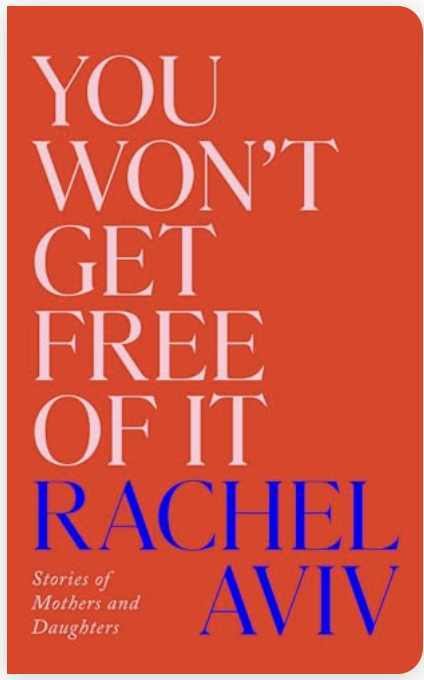
I have been thinking about all of this because I just read Rachel Aviv's new book, You Won't Get Free of It: Stories of Mothers and Daughters, and I'm still digesting it. Aviv, a staff writer at The New Yorker, says she wrote many of these stories feeling, existentially, like a daughter, then reread her own reporting after becoming a mother and found the story she'd missed the first time: the mother's longings, her humiliations, her needs. A mother and a daughter can live through the same moment and remember two entirely different events.
Rachel Aviv's writing on mental health was awarded a Rosalynn Carter Fellowship, an Erikson Institute Prize for Excellence in Mental Health Media, and an American Psychoanalytic Association Award for Excellence in Journalism.
You do not get free of it. Most mothers are self-sacrificing, and much of that sacrifice takes the shape of protection: the hard secrets buried, the family stories quietly sealed. Every family has them (23andMe will tell you as much). But burying is not erasing. What one generation hides, the next often inherits without ever being told what it is.
Love That Travels the Distance
The story that stayed with me was Emma's, a Filipina mother who leaves her own nine children to raise other people's children and send money home. She feels removed from her children; they feel removed from her. I recognize that ache from my work. It is the same ache a parent carries when they send a child away to receive the care they cannot give at home. You can send money home, or tuition, or letters. You can't send yourself. And the child on the other end often feels abandoned instead of loved.
When Mental Illness or Addiction Sits Between You
It is harder still for the mothers and daughters with real mental illness or addiction between them. There, the protecting takes on a different weight: a mother trying to shield her daughter from the consequences of her illness, her addiction, or both, and often unable to. A mother in that position is loving someone she cannot fully protect — one of the hardest things I witness in my work.
Why Mothers and Daughters Are Each Other's Harshest Critics
There is so much anticipation and hope when you have a daughter. It is beautiful, and it is also fraught. I have found that no one judges me more than my mother and my daughter. They love me, and they are also my harshest critics. And I do the same to them: I hold my mother and my daughter to a standard I would never hold anyone else to. Why is that? I think it is because the stakes are so high between us. I want my mother to understand me, and I want my daughter to be okay, more than I want almost anything else. When we fall short of each other's hopes, it cuts deeper than it would from anyone else, because we are so bound up in one another.
Holding Space for What We'll Never Fully Know
You don't know a person until you've walked a mile in her shoes. That goes for your mother. It goes for your daughter. You will not know your mother's whole story, and she will not know yours. So we hold one another with love and understanding, knowing that each of us has endured something only the one who lived it can fully grasp.
That is the work I do every day at Crossbridge, holding the whole family and not only the child in crisis. It is also the work of being a daughter, and a mother. The goal was never to know each other completely. It is to hold space for one another's unknown, and to give grace when understanding feels out of reach.
If you are somewhere in the middle of any of this, I would love to hear from you. I am also still working out what it means to parent a young adult, and how that role keeps shifting. I will write more about it soon. If you are living it and want to help me think it through, reach out, and I will give you a shout-out.
A Few Places to Go Next
If this stirred something:
It Didn't Start With You, Mark Wolynn: how inherited family patterns move through us, and how to interrupt them.
What My Bones Know, Stephanie Foo: a daughter's memoir of inherited trauma and repair.
By Jennifer Benson, MSW — partner at Crossbridge Consulting. Jennifer guides families through therapeutic and educational placement decisions, work shaped by both her clinical training and her own experience as a daughter and a mother.
