
When Your Child Refuses The Help They Need
I have a client who can look me in the eye, promise me he is done using, mean every word of it, and use that same night.
The relapse is hard on a family. The promise that came an hour before is harder, because he meant it, and because there is no way to square the kid who made it with the kid who broke it. Parents can carry an enormous amount. What undoes them is the whiplash of a child who swears things will be different and then, almost in the same breath, proves otherwise. None of it makes sense if you are a reasonably stable person applying logic to it. It was never going to.
My own son got sick and tired of being sick and tired, and one day he told me he had hit his bottom. His story put a question in my head that I have never fully answered for myself, and that parents ask me all the time: does a person actually have to hit bottom before they will change?
I hope not.
Why your child is refusing treatment
The young people I worry about are not turning down help to be obstinate or confrontational. Some genuinely don't believe they are as sick as they are. Some are buried so deep in shame about what they have done that owning any of it feels too overwhelming too bear. Some are still too young to see past the next hour. And some are far enough into an addiction that the part of them that wants out can't get a word in edgewise.
Meanwhile the parents have done everything right. They got them the help, the support, the treatment path … a way out, and their kid looked at it and rejected it, and resented their parents for proposing it in the first place.
I used to find that baffling. I don't anymore. Change is harder than staying sick. People will hold onto the devil they know long after it has stopped doing anything for them but keep them company, because at least it is familiar, and the alternative asks them to give up the one thing that has reliably gotten them through.
Anosognosia
Sometimes the refusal is not denial at all. With schizophrenia and some other serious mental illnesses, the illness reaches the very part of the brain that would notice something is wrong. The clinical word for it is anosognosia, and it is a symptom of the illness, not a choice the person is making. You cannot argue someone out of it, any more than you can argue someone out of a fever. (Xavier Amador's book, below, is the place to start if this is your family.)
Why mental illness is not like physical illness
This is where mental illness and physical illness differ. When someone is physically sick, they usually fight to get well. They want the medicine and they follow the doctor’s instructions. Mental illness is crueler than that, because it goes after the wanting itself. Addiction takes over the machinery that is supposed to make a person reach for what's good for them. Depression drains the motivation to bother. Psychosis quietly edits what is real. We keep asking these kids to want their own recovery, and a lot of the time the illness has already gotten to the want.
Do you have to hit rock bottom to change?
Not always, and I would never wish a bottom on anyone, because for some people the bottom is the part they don't come back from. But something has to shift, some moment where staying the same finally costs more than changing would.
You do not have to wait for that moment, and you should not. The clinicians behind the book Beyond Addiction make the case, with decades of evidence, that waiting to "hit bottom" is one of the least effective approaches a family can take. We cannot manufacture the moment a person decides to change. What we can do is stop softening it.
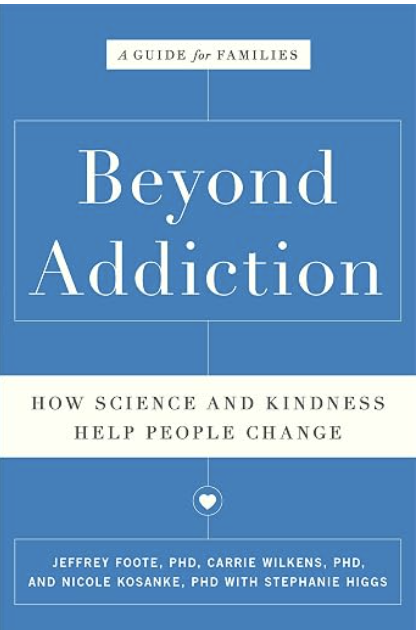
Purchase Beyond Addiction here and a portion of the proceeds will be donated to The Sky’s The Limit Fund.
What parents can control
You control what you can control. I say that to parents all the time, and I am aware of how thin it sounds when it is your own child coming apart in front of you. But it is the truth. If your child is home from treatment, you hold the home agreement, and you hold it on the nights it would be so much easier to let it slide. You don't renegotiate it with the version of your child that is sick. You keep the boundary where it is and you keep the door open, which is so much harder than it sounds, because it means watching them run into consequences you would give anything to spare them.
You can't pick the bottom for your child. What you can do is stop quietly raising the floor every time they fall, so that the fall finally registers.
Safety comes first
Underneath all of it is the one thing that is not negotiable, which is safety. Before anything else, your job is to keep your child safe, and there are times that means requiring treatment they do not want and being cast as the villain for it. If your child has to resent you for a while so that they are still here to resent you, that is a trade worth making. Relationships heal over time. They heal as the young person heals, as they grow up and the brain finishes developing on its own schedule, and as the right kind of treatment, the patient and compassionate kind, does its slower work. I have watched more than a few furious teenagers turn into grateful adults, not all of them, but enough that I will tell any parent to put safety first and trust that the relationship can be repaired later.
Resources for familes
Beyond Addiction: How Science and Kindness Help People Change, by Jeffrey Foote, Carrie Wilkens, and Nicole Kosanke of the Center for Motivation and Change. It makes the case that you do not have to wait for rock bottom, and that kindness and boundaries were never opposites.
I Am Not Sick, I Don't Need Help!, by Xavier Amador. If your child genuinely cannot see that they are sick, start here. Amador, whose own brother had schizophrenia, explains that the not-knowing is itself a symptom, and gives you a way to talk about treatment that doesn't end up in conflict. It also covers what to do when treatment has to be required.
Hopestream, a podcast by Brenda Zane, a CRAFT-trained parent coach who nearly lost her own son and now walks parents through this exact terrain. Good company for the drive home from a hard visit.
If you are in the middle of this right now, you are not the only one, not by a long shot. This is the work we do every day at Crossbridge: helping families hold the line, find the right treatment, and take care of themselves while they do it. If your family is in it, you don't have to figure it out alone. Get in touch.
Jennifer Benson, MSW, is a partner at Crossbridge Consulting, where she helps families navigate school placement, therapeutic programs, and the decisions that come with a child who needs something different. [Link: Read Jennifer's full bio.]
