
Where Learning Happens - Part 3
This series of posts was originally given as a keynote speech for the 2026 CERTS Academic Summit in Cedar City, UT.
Balancing Friction and Baselines in Learning
Real learning requires a certain amount of tension; it is the moments where tasks feels most difficult that cognitive and personal growth actually happens. For both educators and families, supporting children means navigating a delicate balance: providing necessary scaffolding while ensuring young people are given the chance to experience, work through, and grow from meaningful challenges.
The Necessity of Friction and the “Zone of No Development"
Young people possess an incredible capacity to handle difficulty, but building that capacity requires practice. Too often, when faced with the discomfort of a challenging task, a student may freeze or opt out. This response rarely stems from an inability to complete the work; rather, it occurs because the student has not yet practiced the skill of sitting with discomfort long enough to reach the other side.
Researchers at Purdue University identified a specific classroom phenomenon that occurs when certain support measures become permanent and that necessary friction never arrives. In these environments, the traditional framework of supported learning collapses into what Santos and Birdwell termed the “Zone of No Development."
When accommodations eliminate all friction, growth is replaced by comfort and dependency. A student may achieve perceived mastery, but never get to true understanding.
The danger does not lie in the tools or accommodations themselves, but rather in using those tools to remove struggle from the exact spot where learning is meant to occur.
Isolating the Friction
To keep expectations high without causing a child to shut down, adults must deliberately choose where the friction should live for a specific learner.
Consider a complex writing assignment based on a dense literary text. Expecting a student to analyze deep symbolism, structure an advanced argument, and master complex new syntax all at once can create friction on too many fronts, leading to overwhelm.

Expecting a student to analyze deep symbolism, structure an advanced argument, and master complex new syntax all at once can create friction on too many fronts, leading to overwhelm.
Instead, the assignment can be strategically parsed:
For one student: The mechanics of syntax may already be automatic, so the friction lives entirely in the high-level analysis of the text's theme.
For another student: The primary focus might be writing a clean, structured summary to master specific syntax patterns, keeping the structural expectations manageable while targeting a distinct growth area.
By isolating the friction, the core content remains robust, but the targeted challenge is tailored to what each individual child is ready to tackle.
The Trap of Peak Performance vs. Honest Baseline
In both homes and classrooms, it is remarkably easy to fall into a common psychological pitfall: treating a student’s peak performance as their daily baseline. (And hey, for the high achieving adults in the room, we do this to ourselves, too.)
When a child experiences an extraordinary day with sharp focus and high output, adults frequently file that anomaly away as definitive proof of daily capability. It leads to familiar phrases like, "I know you can sit through this entire period quietly, because you did it yesterday," or "I know you can write like this because I have seen you do it before."
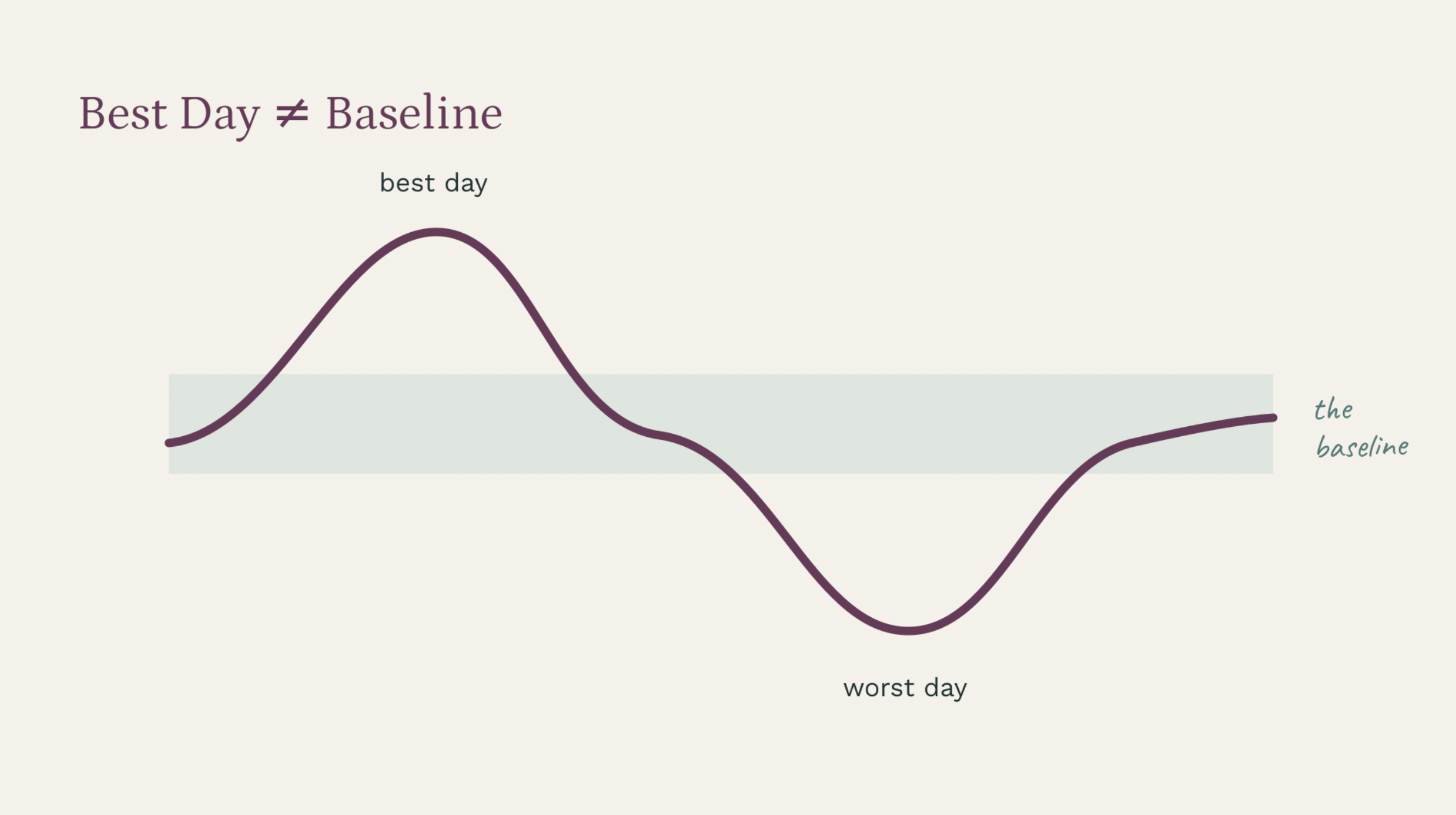
Emerging skills naturally fluctuate.
While a peak performance proves that a capacity exists within a child, it does not mean they fully own or control that skill yet. Emerging skills naturally fluctuate. They appear one day and recede the next based on a variety of environmental factors, from a difficult morning routine to basic fatigue.
Real growth is not about forcing a child to live permanently at their peak. Growth is the slow, steady upward movement of the true baseline: watching the ordinary day gradually rise toward what used to be the ceiling.
Practical Implementation: The Two-Degree Shift
Fostering resilience and genuine capability does not require a massive structural overhaul at home or at school. It happens through small, intentional choices—what can be thought of as a two-degree shift.
Adults can look for everyday moments to locate the exact edge of a child's capability:
In the classroom: Utilizing brief checks for understanding or exit tickets allows educators to adjust the next day's friction, turning the dial up or down based on real-time feedback.
At home: Waiting until you’ve seen a child doing a skill independently 3+ times before fully removing scaffolding. Stay present and playful in the meantime and you’ll create cognitive muscle memory.
The real gift we can offer children isn't a cleared path, but the capacity to navigate obstacles on their own. When we resist the urge to over-accommodate or demand perfection, we leave room for the small, quiet shifts where actual development happens. Long after school facts fade, what stays with a child is the ability to tolerate friction and find their footing. That is how they build the steady, unglamorous muscle of independence—the simple capacity to face hard things and keep going.
Rebekah Jordan, M.Ed., is founder and partner at Crossbridge Consulting, where she helps families navigate school placement, therapeutic programs, and the decisions that come with a child who needs something different.
