
How a Long Recess Creates Strong Humans
Think about the qualities we want our children to develop on the way to becoming inter-dependent, healthy, confident, capable adults: Resilience. Confidence. Problem-solving skills. Negotiating and perspective-taking skills. Stick-to-it-ness. The ability to compromise. The ability to treat other people ethically.
All of those are built and nurtured on the playground during free play.
Not exclusively, of course. But the playground is where children practice these capacities in real time, with real-to-them stakes, and without a script. And the research increasingly supports what many educators and parents have observed: the amount of time we give children to play changes what play can actually do for them developmentally.
What a Play Arc Looks Like
Play follows a pattern. If you've spent time watching children in unstructured play settings, you've likely seen it, even if you didn't have language for it. Each stage builds specific skills, and cutting the arc short means cutting off access to the stages where some of the most important developmental work happens.
🔎 Finding Your People
The first thing children do when they enter an open play space is wander. They're scanning.
“Do you want to play together? “
“Sure. Do you want to play together? “
“Sure.”
They're finding their little gang of co-creators. This part is quick and social and can look aimless from the outside. There are invisible dynamics at work. Children are making choices about who to align with, reading social cues, and initiating contact. It's the social scaffolding for everything that follows.
🗣️ The Negotiation
Once the group is assembled, the planning starts. If you've ever eavesdropped on a group of five-year-olds deciding what to play, it’s one of the most entertaining conversations you’ll ever hear:
“We're playing pirates.”
“No, I don't want to play pirates. We're playing Princess and the Tower!”
“We played Princess already. You be my pet dog and I'll be the cat, and then Jimmy can be our mom, but he’s a bird!”
What you're watching is negotiation and collaborative world-building. Children are masters of improv; the "yes, and" hasn't been trained out of them yet, and it's really fun to watch. Because what can come out of that discussion is something like: Okay, well, I'll be the pirate and you be the princess in the tower, and he can be your dog, and I'll be the pirate's cat. A magnificent mashup that nobody planned, built from the willingness to stay in the conversation long enough to find something that works for everyone.
Peter Gray, the Boston College research professor whose work on self-directed play has shaped much of the contemporary conversation around children and free play, writes in Free to Learn (2013) that when children play imaginative games together, they do more than exercise their imagination: they enact roles, practice the art of negotiation, and learn that getting along and making agreements with others are among the most valuable of human survival skills. Gray's broader views on formal education lean towards the radical (he's closely associated with the unschooling and self-directed education movements), but his research on what happens within play is widely respected and extensively cited in developmental psychology.
Gray puts it this way: play would perhaps be more respected if we called it something like "self-motivated practice of life skills," but that renaming would remove the lightheartedness that is critical to its effectiveness. We have to accept play's inherent playfulness in order to let it do its work.
Sometimes, during the negotiation phase, someone decides they don't want to play what the group has chosen. They might drift to another group. Or they might stay with the people they want to be with and propose something new entirely. Either way, they're making decisions about relationships, compromise, and their own boundaries. And they're doing this at four and five years old, in real time, with no adult directing the outcome.
🚀 The Story Takes Off
This is the exuberance phase. The pirates breach the ramparts. The princess calls for rescue. Someone is feeding an imaginary cat.
Ahoy! Help! Meow!
In these moments, the children are collaborating inside a shared narrative, building on each other's contributions in real time, continuing to create as they play. The "yes, and" is still happening, and the story keeps evolving.
And then, almost invariably, a problem enters the narrative. A kid jumps in from across the field: No, you can't rescue her. I'm the big ogre. I'm going to stop you.
Now there's an obstacle. The drawbridge is on fire. They can't go that way. The players might start building physical structures with whatever materials are available (planks, blocks, a wheel, loose parts) to circumvent the imagined obstacle. They might invent entirely new plot lines. This is where the cognitive work deepens: imagining, strategizing, problem-solving, tolerating the reality that your first idea didn't work and you need to generate another one.
This is where play starts to look like the resilience, creativity, and persistence we said we wanted our children to develop.
At this point, the children have been playing for maybe 15-20 minutes.
⏰ Imagine what happens when the bell rings right here. The problem has just been introduced. The children haven't gotten into solutions yet. And they haven't reached the most critical stage of the play.
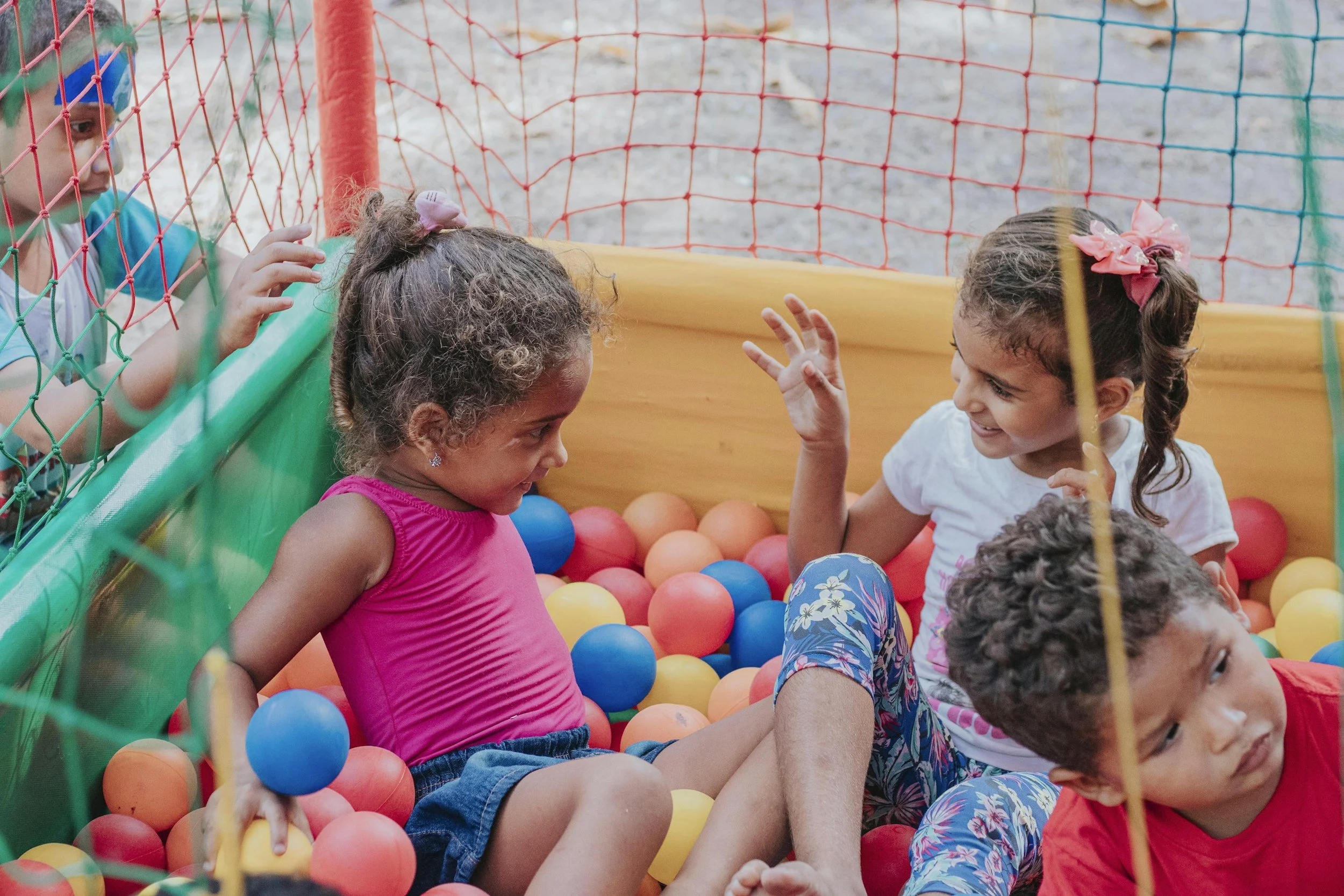
Photo Credit: Carlos Magno
Angela Hanscom, a pediatric occupational therapist, and author of Balanced and Barefoot, wrote a widely cited piece for Edutopia in 2016 on the developmental case for longer recess. Drawing on observations from her organization's summer camp program, Hanscom reports that it consistently takes an average of 45 minutes of free play before children get into what she describes as complex, evolved play schemes. If recess lasts only 15 to 20 minutes, children are still figuring out who they'll play with and what they'll do before it's over. They rarely, if ever, reach the stages of imaginative play where the deeper developmental work actually happens.
Hanscom identifies three categories of benefit that require longer play periods to emerge: creative play (the kind of sustained imaginary world-building described above), social-emotional development (which requires real-time, unscripted peer interaction), and physical regulation.
I had always valued longer play periods for the social and creative benefits. But Eric Jensen's neuroscience research in Teaching With the Brain in Mind (first published 1998, revised 2005) makes a compelling case that the body itself needs more time to move through its regulation cycle than most recess periods allow. Jensen's work suggests that a short recess can actually increase arousal rather than regulate it, potentially leaving children more activated and less able to concentrate when they return to the classroom. The child who comes back from a 15-minute recess wound up and unable to focus may not be demonstrating a behavior problem. They may be demonstrating exactly a predictable nervous system reaction: ramped up without having had the time to come back down.
This is not a 30-minutes-or-don't-bother argument. Short breaks do have real value. Ten minutes to move your body, breathe fresh air, and reset can be incredibly regulating. Those shorter windows serve a purpose, and I would never advocate for eliminating them. But they serve a different function than what happens when children have 30, 40, or 45 minutes of unstructured time together. Too often we treat them as interchangeable.
🥊 The Interpersonal Conflict
Back on the playground, the story is rolling. But now something shifts between the players themselves, not just within the narrative. Maybe someone's pet dog has turned into a dragon, and another child had a completely different vision for where the story was going. The agreed-upon premise has changed without consensus.
The child has to make a series of rapid, sophisticated assessments. Do I want to keep playing? Is this something I can tolerate? Is it a compromise I can make? Is it a compromise I'm willing to make? Are my feelings really hurt? Will the other person apologize? Do I need to get my way, or can I let this go?
These are the same questions adults navigate in workplaces, marriages, friendships, and communities, and many of us still struggle with them. Children on a playground are practicing these assessments in a context that feels genuinely high-stakes to them (because it is), with the added pressure of wanting to stay in the game.
This is also the moment where a child might seek out an adult.
So-and-so won't let me . . .
The adult's role in this moment is not to solve the problem. It's to invite the child to slow down. To think about alternatives and perspectives. To help someone who isn't okay with how things are shaking out figure out what they need, and to make a different choice. The goal isn't to eliminate the discomfort. It's to help the child build the capacity to sit in it and find a way through.
Without enough time to reach this conflict, we're cheating kids out of the essential experience of rupture and repair. Children need to understand, and not just intellectually but in their bones, that rupture is not the end of the story. That when there's a problem, you can persevere through it. That it is possible to be the one who compromises and still get something of what you need. That the friendship, the game, the relationship can survive the disagreement.
Gray's research supports this directly. In his 2011 paper "The Decline of Play and the Rise of Psychopathology in Children and Adolescents," he argues that free play is essential for developing conflict-resolution and self-regulation skills precisely because it forces children to negotiate without adult intervention. When we supervise and direct children through every disagreement, they don't develop the internal resources to manage those situations independently / interdependently. The decline of free, unsupervised play, Gray contends, is a significant contributing factor to the rise in childhood anxiety and depression over the past several decades. At Crossbridge, we see this in real time, all the time. Young adults who went through an educational system that rewarded “correctness” rather than experimentation, and as a result, never built the skills to feel comfortable in uncertainty.
📖 What the Research Community Is Saying Now
The American Academy of Pediatrics first published its policy statement "The Crucial Role of Recess in School" in 2013, calling recess "a necessary break in the day for optimizing a child's social, emotional, physical, and cognitive development." That statement was reaffirmed in 2023. And in spring 2026, the AAP published an updated and expanded version that extends the recommendation through 12th grade and calls for recess to be a protected daily block that is never withheld for punitive or academic reasons. The updated statement specifies that multiple breaks with a minimum of 20 minutes are needed for children to receive the full cognitive, physical, and social benefits, and that recess and physical education are complementary but not interchangeable. Having watched these scenarios play out in real time, I would argue that 20 minutes still isn’t enough.
The conversation around play, recess, and children's mental health has only intensified in the wake of the pandemic. The AAP's decision to strengthen and expand its recess guidance signals that the research community is taking the connection between unstructured play and developmental outcomes seriously. Despite this, average weekly recess time in U.S. schools has declined by 60 minutes over the past two decades, and more than 75% of school districts do not have a formal policy requiring recess at all. Only two states (Arkansas and Illinois) mandate more than 30 minutes of daily recess. The gap between what the research supports and what most children actually experience is large and unresolved.
🤝 Resolution (and Sometimes, Chapter Two)
When children have had enough time to move through the interpersonal conflict, reach some version of resolution, and then continue playing, they've experienced the full arc. They know that disagreement doesn't have to mean the end of the game or the end of the friendship. They've practiced perseverance in a context that felt real. They've lived through rupture and repair.
And sometimes, they pick up the story the next day and write the next chapter.
🚌 What to Look For When You're Exploring Schools
If you're a parent exploring schools for your child, the way a school structures and protects play time is one of the clearest indicators of what that institution believes about children and how they develop.
How much unstructured play time do children actually get, and is it in blocks long enough for a full play arc to unfold? Is it one 15-minute sprint, or are there longer stretches built into the schedule? What do the play spaces look like? Are there open-ended materials that provoke rather than dictate, or is everything predetermined? And when conflict arises between children, what do the adults do? Do they solve the problem, or do they support the child in solving it themselves?
How institutions choose to use their schedule matters. What they put on their walls matters. What you see people doing in classrooms, on fields, and in hallways matters. The environment a school intentionally creates tells you what its values are, and how it cultivates play (and the resulting resilience, creativity, perspective-taking, and joy) for its students.
These are the conditions in which children practice becoming the adults we hope they'll be.
Citations:
Peter Gray, Free to Learn (2013): Amazon
Peter Gray, "The Decline of Play and the Rise of Psychopathology in Children and Adolescents" (2011): ResearchGate
Angela Hanscom, "Longer Recess, Stronger Child Development," Edutopia (2016): Edutopia
Eric Jensen, Teaching With the Brain in Mind, 2nd ed. (2005): ASCD
AAP, "The Crucial Role of Recess in School" (2013): Pediatrics
AAP, "The Crucial Role of Recess in School" updated policy (2026): Pediatrics
Cas Holman, Playful and Rigamajig: casholman.com