
Learn How to Apologize - For Real
A few years ago, we came across this graphic from a conversation that Brené Brown had with Harriet Lerner, psychologist and author of Why Won’t You Apologize?
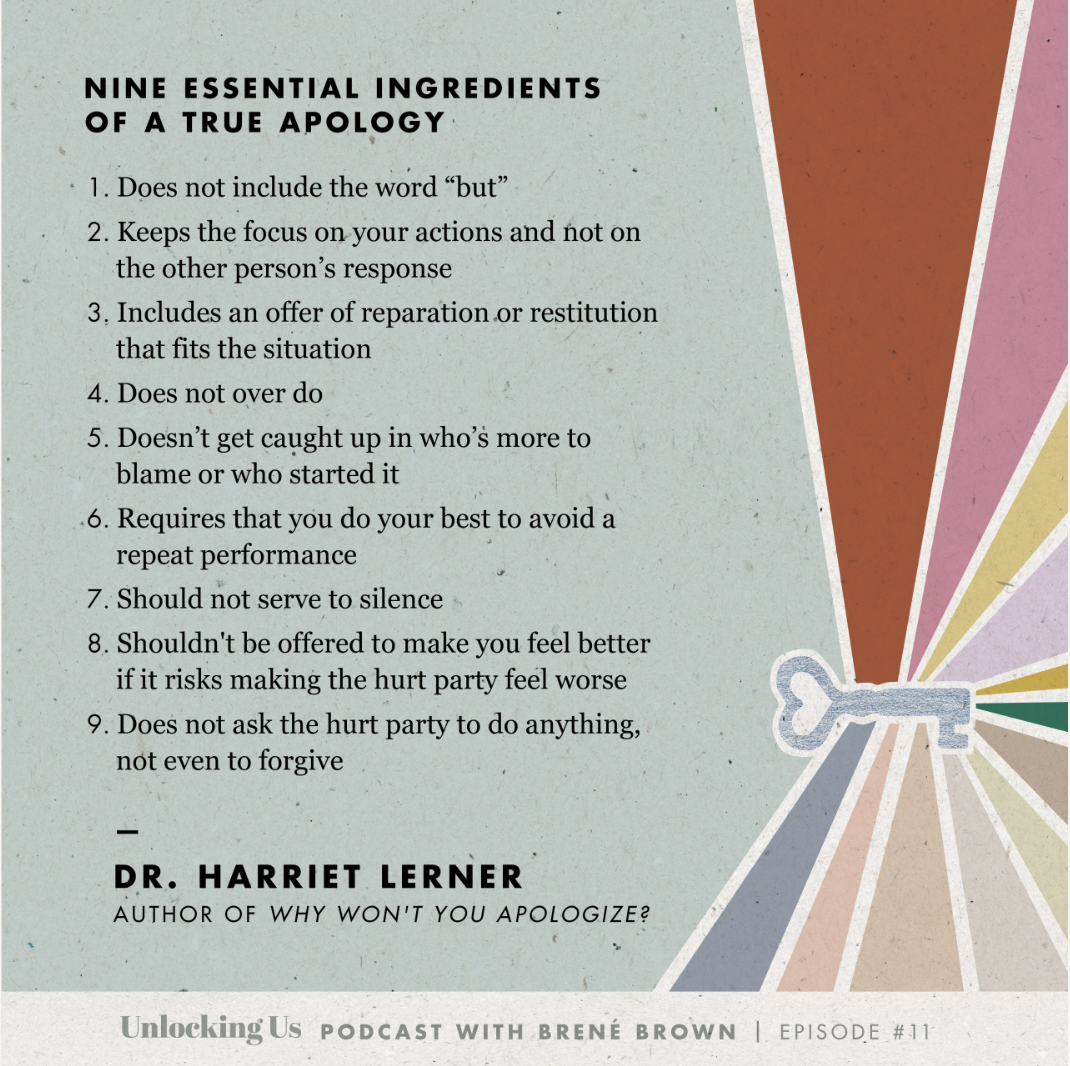
At the time, it was like a gentle, loving gut punch. I (Rebekah) thought that I was adept at apologies. I’m highly verbal, generally explain things well, and value compassion. But despite all of that—and also because of it—I really bombed when it came to giving what Lerner would categorize as “true” apologies.
Looking at the list, I think I was solidly nailing only 1 out of the 9 “Essential Ingredients” (#7 in case you’re curious.) The rest were hit or miss depending on the content, the context, or how contentious I was feeling.
So, yes, reading this list for the first time was deflating.
From Sean:
“For me, the list landed differently.
I didn’t struggle with saying I was sorry. I struggled with what came after. I wanted apologies to function like a reset button: I name the mistake, express regret, and we move on.
What I didn’t really get then was that a real apology isn’t about relieving my discomfort. It’s about making room for the other person’s experience, even when it doesn’t feel good.”
There were moments in our co-parenting when we both wanted credit for trying, for meaning well, for being willing to come back to the table. And what we had to learn (sometimes slowly and painfully) was that good intentions don’t undo a hurtful impact. Apologies that center the apologizer tend to shut things down, not open them up.
Learning to apologize “for real” meant we had to learn to tolerate the part where the other person didn’t immediately feel better. Where we had to sit in the mess we had made.
That was humbling.
Why Apologies Matter So Much in Co-Parenting
We’ve written a lot about adult responsibility: about not competing, about not putting kids in the middle, about taking responsibility for your own emotions so children don’t have to.
Apologies are right at the center of all of that.
Because co-parenting doesn’t require perfection (thankfully). It requires repair.
Kids are constantly watching how adults handle missteps. Not just the big, dramatic ones, but the everyday ruptures. The sharp tone. The missed handoff and the gripes that follow. The moment someone felt dismissed or unheard.
When adults don’t apologize well — or at all — kids learn that power matters more than accountability. That relationships are brittle. That being right is safer or more important than being honest.
But when they see adults say, “I got that wrong. I see how it affected you. I’m sorry.” we’re modeling something entirely different. These pathways are what imprint on them.
A real apology doesn’t erase what happened. It integrates it.
What We Mean by “For Real”
A “for real” apology is not:
“I’m sorry you felt that way.”
“I’m sorry, but…”
“I’m sorry, I was just …”
And it’s also not self-flagellation or a bid for reassurance. (These only serve to bring the attention back to you and takes it away from the person you’re apologizing to.)
A real apology names the impact without defending your intent. (Yep, for real.)
It resists the urge to explain and it doesn’t rush the repair.
The benefits of this in co-parenting, are that it keeps the focus on the relationship. It doesn’t focus on who was right, who was justified, or who had the harder day.
This is slow work. It requires regulation. It asks us to stay in moments we’d rather escape.
But over time, apologies really are the key to a sustainable partnership: it builds trust where it might have been lost. It creates flexibility instead of rigidity. It keeps space open for forward movement.
Apologies Tie Everything Together
Zoom out, and we can see how this rule weaves together with Rules 1-5:
Rule #1 asked us to put the child’s needs first.
Rule #2 asked us to let go of competition.
Rule #3 asked us to keep adult conversations with adults.
Rule #4 asked us to let the kids be exactly where they are.
Rule #5 asks us to own our impact, making repairs for anything that’s gone wrong with Rules #1-4.
What we’ve found is that when we can apologize well, we can repair well.
And repair is what makes long-term co-parenting sustainable.
Not perfect.
Not seamless.
But honest, humane, and workable.
That’s the goal.
And the key icon on the graphic may be coincidental, but it’s not lost on us that a solid practice of healthy apologies is the key to unlocking stuck energy in a relationship.
While we could try, there is no doubt that Lerner summarizes this better than we ever could when she says:
"We’re all connected, we all screw up, we’re all imperfect human beings, and for this reason, the need to give and receive apologies, will be with us until our very last breath. And when they’re done right, apologies are very healing, but when apologies are absent, or they go south, it will compromise a relationship, or it can lead to the end of a relationship. So apologizing is… It’s central to everything we hold dear, to family, to marriage, to leadership, to parenting, to our ability to love ourselves and love other people. Apologizing is at the heart of it."
Thanks for staying with us through this series. We recognize the limits that short-form writing has on our ability to touch on every circumstance that co-parents might be dealing with. It’s especially obvious that most of what we’ve discussed is predicated on co-parents who are at least semi-committed to a working relationship and children who are safe, no matter which parent they are with. When this isn’t the case, different sets of rules may be more effective. And at the end of the day, we still believe that these rules are good ones to live by, even just as a human moving through the world.
We’re grateful for your time, and if you’re interested in hearing more, don’t hesitate to reach out. We’re always open to speaking with a group, guesting on podcasts, and generally being a resource for any parents, no matter where you are on your journey.
All our best,
Sean & Rebekah